
Table of contents
The Faroe Islands
Kirkjubøreyn, February 3rd
The decision to set off
Suffering a fall
In the emergency ward
Ferry boat trip to Nólsoy, February 6th
Aftermath
The following text is a personal reflection on a misadventure in February 2024 during a stay on the Faroe Islands.
The Faroe Islands
The Faroes are a group of eighteen islands in the North Atlantic Ocean, boasting beside their comparative remoteness with erratic, unpredictable, and generally harsh weather all year round.
Like most other people, I did not get to this archipelago by means of a ship or ferry service, but by plane from Copenhagen, conducted almost like a domestic flight for the Faroes belong to the Kingdom of Denmark (yet not to the European Union, so you have to go through customs).
One of the first things you are going to notice when arriving on the Faroes is that there does not exist much of a striking or complex vegetation, such as trees, the overall impression is that of a barren, undulated, and rugged lunar landscape with smaller and larger lakes and cascades scattered about, but surprisingly, the islands are not entirely devoid of plants, you can find the kingcup flower in spring here and there, for instance.
Also, besides sheep and lots of different bird species, there barely exists any larger-sized animal, but you can encounter the occasional rabbit (or hare) outside the settled areas if that counts.
As mentioned, the islands are anything but flat, a matter that was of some importance to me. The highest elevations hold 880 meters (Slættaratindur) and 856 meters (Gráfelli) above sea level, respectively. These mountains are located in the north of Eysturoy, one of the two main islands.
Kirkjubøreyn, February 3rd
Doing small hikes in the vicinity of settlements like the capital Tórshavn are reasonable outdoor activities during winter time. On this day, however, bad luck would call on me, I will elaborate on that later.
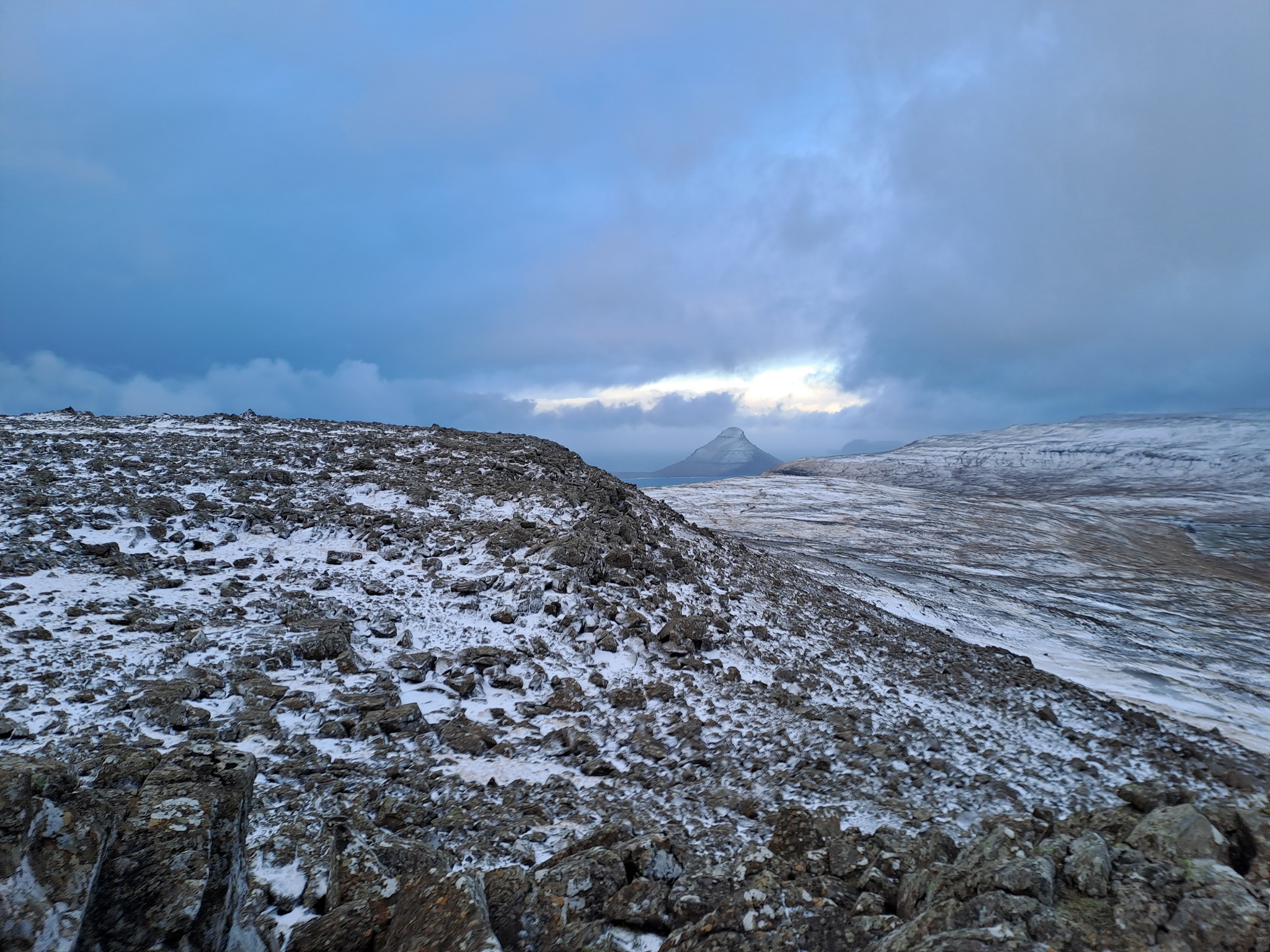
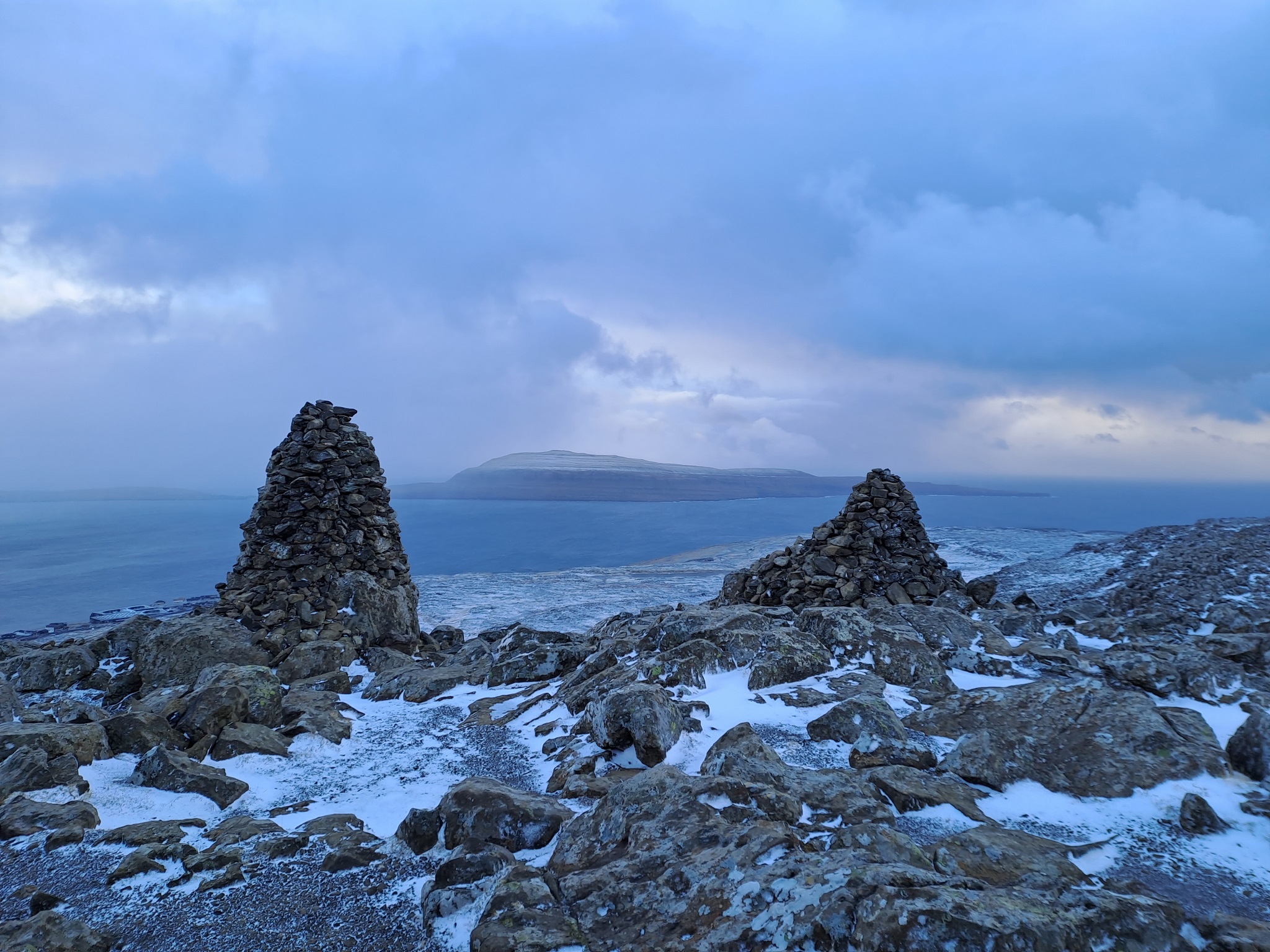
Firstly, Kirkjubøreyn is a rocky hill of about 350 meters, located southwest of Tórshavn. It offers a splendid and expansive view over the southern tip of Streymoy, the second of the two main islands, and to Nólsoy, a smaller island in the east.
The decision to set off
I was almost at a point to call it quits that morning, for the weather seemed to get not better but worse, but then the clouds suddenly cleared and the rain stopped what appeared to give me a brief window. I made up my mind and decided not to return to my hotel, that was about thirty minutes walking distance from where I was standing. A poor decision, as it turned out.
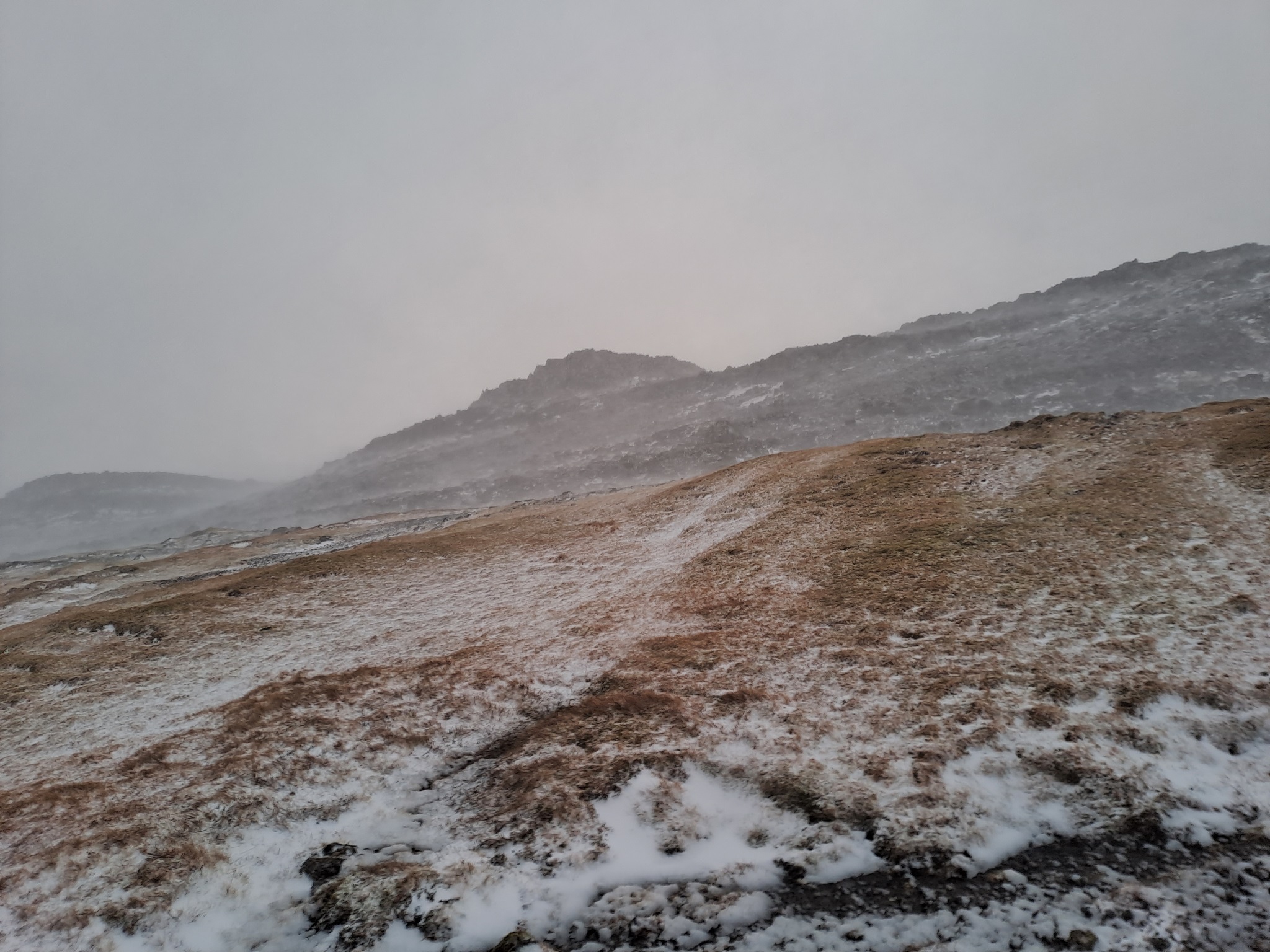
My body was itching for exercise, so I left the asphalt road in order to get to something that looked like a path at the hill’s foot. I passed a few farm houses and proceeded up in rather quick fashion since orientation was not much of a problem, for stretches of time the mist had disappeared.
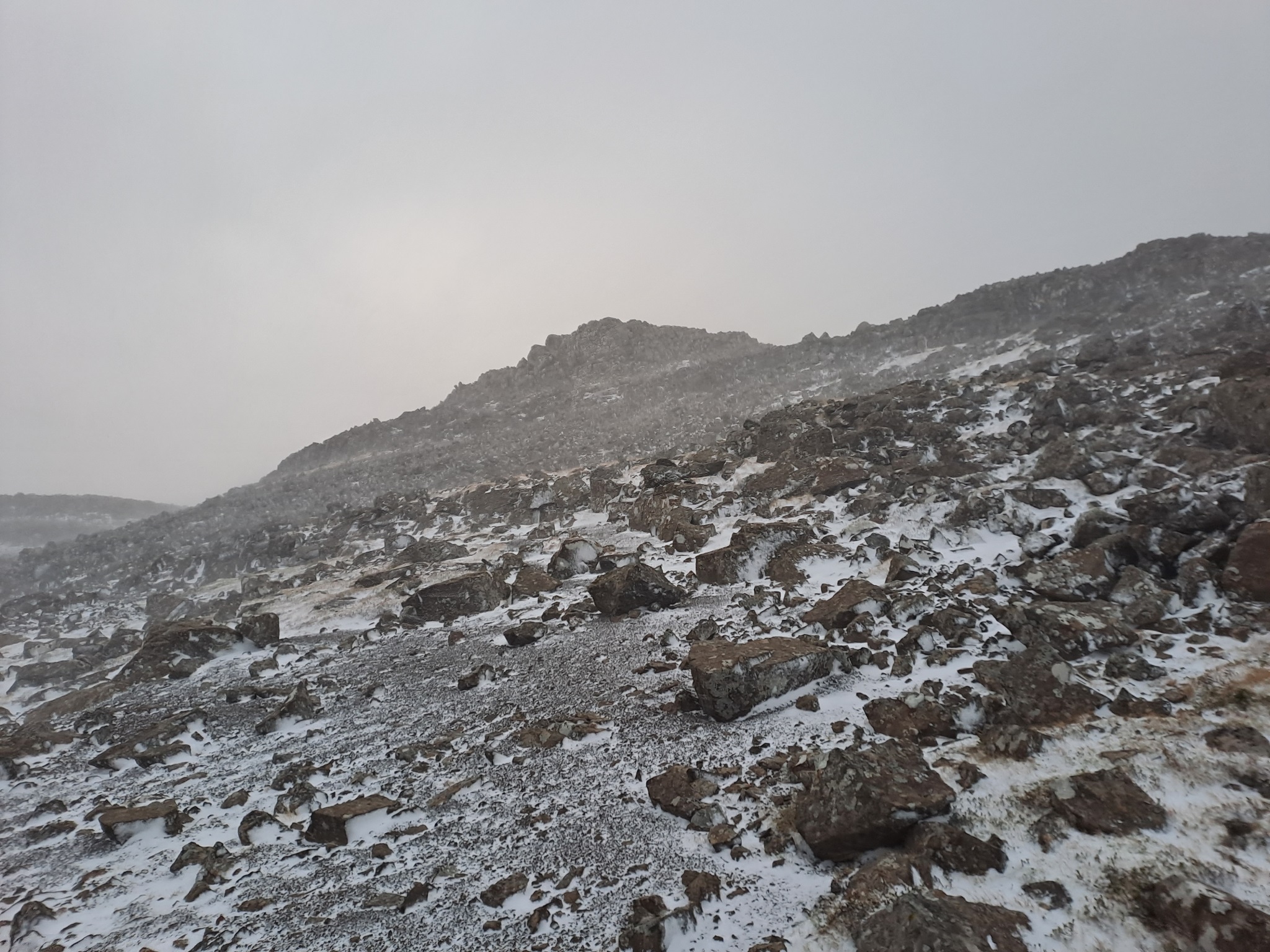
I took care to keep my footing on very slippery ground consisting largely of grass and mud, then snowy rocks, but I was fairly sure I am able to get to grips not only with the weather but also with this suspicious ground at the hill’s slopes.
As I was walking around at the top area, which seemed very extensive and worth exploring, making a couple of photos, I felt a looming sense of apprehension, inexplicable to me at that moment.
“Well, the weather isn’t good, and I’ve seen no people for a long time, but here it is neither steep nor high up so what are you worried about?”, I tried to comfort myself. Nonetheless, I hurriedly stashed my photo equipment after looking up the sky, and made for the descent before the foggy clouds got again hold of this place.
Suffering a fall
Letting your mind wander in the mountains while still in demanding terrain is something you should train yourself never to do.
I was almost down from Kirkjubøreyn, the asphalt road two hundred-odd meters off maybe, and the very last steeper slope in front of me.
I had a bag of gummy bears in my backpack, and I considered it the right time to eat them as a small reward. “Relax man, the weather is terrible now but you’ve done it, so look forward to a beer later this day, maybe check out the gym in the town’s center”.
So were my thoughts as I made a few steps forward when I suddenly lost the grip on my right foot and slipped.
Unfortunately for me, my left foot was stuck in the mud and didn’t follow the motion in line with the other parts of my body, what would have meant just falling rather softly on my buttocks.
My left leg was twisted behind my back, and as my rear end impinged on my left foot as I slided a meter or so down the hillside, I felt that something in my ankle snapped.
There was no pain, however, yet the moment it happened it was clear that I wasn’t okay anymore.
Quite shocked, I got up and limped to a big rock near one of the farm houses, sat down as “no, please not… everything but an injury here” ran in big letters through my head.
I knew that a bus stop wasn’t far off, this was the good news, and this bus had a stopover at the “National Hospital of the Faroe Islands.”
Filled with a feeling of defeat I stood up, and limped carefully but fast to the bus stop in fear of swellings getting too bad.
In the emergency ward
I had no idea what exactly happened to my ankle, but I was fairly certain my bones weren’t crushed, what the X-ray examination in the hospital confirmed. Beyond that, the hospital did not have any devices to examine ligaments or ruptured tissue in my foot.
So what can or should be done? I had experienced injuries in the mountains and elsewhere before, and these days you can make your own research of medical matters via the internet.
This, of course, has to be carried out with the necessary skepticism and common sense. But the truth is, you are (or should be) the expert in issues concerning your own body, and should not blindly trust any doctor who comes across.
So as I found myself in front of two doctors in the hospital, I had to make a second crucial decision this day. Go along with their recommendation for a two-thousand Euros surgery, or leave the hospital on those crutches they handed me over, just like that.
I went for the second option, and this time my decision proved right, though I wasn’t so sure about it at first. The next morning, my foot was badly swollen, and a vast, ugly hematoma was about to form.
Ferry boat trip to Nólsoy, February 6th
The next two days I spent in the hotel bed, palpated my leg and my foot trying to figure out more about how serious the injury was, and cooled the thing as best as I could.
There was some sort of relief after a while, however, since there was never any serious pain, even when walking about on crutches and putting weight on my foot.
Yet, as you can imagine, my plans to explore the Feroes were effectively over.
One remaining activity was to make a trip on a ferry boat to the island of Nólsoy, a small reconciliation for the uncomfortable experiences I had the last couple of days, even though I bemoaned the fact I could not hike anywhere on the island.
But just marvelling at the beauties of the rough Atlantic Ocean seemed worth the trip.
Aftermath
My flight back to Denmark departed one day later.
A specialist in Germany I visited one and a half weeks after the accident told me what I had already suspected. Surgery isn’t necessary, but I should continue doing what I have been doing: wearing that orthopedic splint, cooling my foot, and taking it easy.
For it seemed to be either just a capsule rupture or sprain of the deltoid ligament (here is one picture of my foot one week after the accident), and apparently wasn’t super serious an injury, he did not even bother to inspect the foot more closely and dismissed me after a few minutes.
As I am writing this, almost three years have gone by, and although I felt the injury and an instability in my ankle joint for several months, my foot made a full recovery. Two months later, I was back in the mountains, a year and a half later I started over my training for running competitions (this long stretch of time was more due to laziness than medical concerns).
One thing I clearly neglected (and literally paid for it) was taking care of sufficient insurance beforehand. The Feroes do not belong to the European Union, so my insurance did not cover even fractions of my costs, as it would have been the case if the accident had happened in Denmark. This was clearly a lesson for doing better research in advance the next time, which I have been doing since.
Hopefully anyone who reads this will have some benefit too. You probably know the old adage commonly attributed to Otto von Bismarck: “Fools learn from experience. I prefer to learn from the experience of others.”
Featured image: On Kirkjubøreyn